
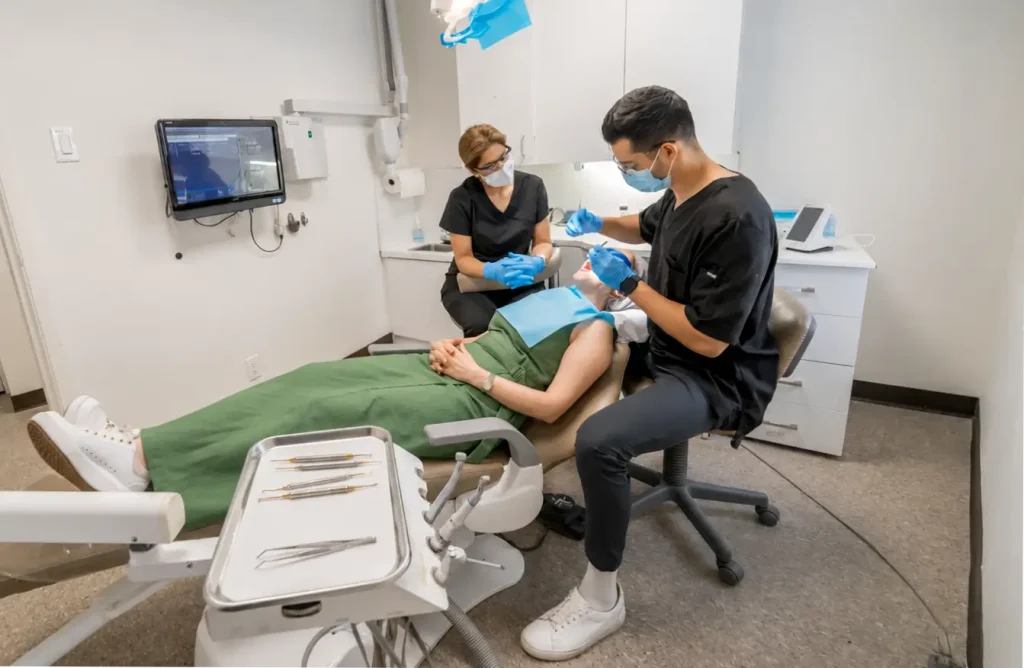
A filling repairs a tooth that has lost structure to decay, a crack, or wear. We use tooth-coloured composite, we tell you which teeth genuinely need work now and which can safely be re-checked, and you get the cost of each option before anything starts.
Speak with our team to schedule your visit or ask any questions before booking your appointment.
What you can feel. A sharp twinge with cold or sweet things. A tooth that catches floss or shreds it. Sensitivity when you bite down on one particular spot. A rough edge your tongue keeps finding. A visible dark line or hole.
What only an exam or X-ray shows. Most cavities are found before any of that happens. Decay between two teeth, where they touch, is invisible from any angle and does not hurt until it is deep. So is decay underneath an existing filling. This is the single best argument for regular checkups: by the time a cavity announces itself, the repair has usually got bigger.
Pain is a late symptom, not an early one. A tooth that does not hurt is not evidence of a tooth that is fine.
Composite is a resin that is shaded to match your tooth and bonded directly to it, then hardened with a curing light. It is what we use for visible teeth and, in most situations, for back teeth as well.
How the appointment works. We freeze the tooth, remove the decayed tissue, clean and prepare the cavity, place the composite in layers, cure it, then shape and polish it so your bite closes evenly. A single straightforward filling usually takes 30 to 45 minutes.
You will be numb for a couple of hours afterwards. Mild sensitivity to cold for a few days is normal, particularly on a deeper filling. Sensitivity that is getting worse rather than better after a week is worth a phone call.
How long composite fillings last. A well placed composite in a well cared for mouth commonly lasts several years, and many last considerably longer. No filling can be given a guaranteed lifespan. What shortens one is decay starting again at its edge, heavy grinding, and biting hard objects.
Amalgam is the silver material used for most of the twentieth century. It is durable and it is still in use, though far less than it was.
Composite is tooth-coloured, bonds to the tooth, and lets us remove less healthy structure to place it, because it does not rely on a mechanical shape to stay put. For most patients that combination is why it is the default here.
If you have existing amalgam fillings that are sound, there is no clinical reason to replace them simply because they are amalgam. We will tell you if one is failing. We will not recommend replacing a working filling for its appearance unless you raise it firs
A partial denture is removable and replaces several teeth at once. It costs less than a bridge or an implant and it is the sensible route when there are multiple gaps, or when the teeth beside the gap are not strong enough to carry a bridge.
A filling replaces missing tooth structure. There is a point where too little sound tooth remains for that to work.
When we recommend a crown instead. If the cavity or the existing filling covers most of the biting surface, or the tooth is cracked, a filling would be doing structural work it is not designed for, and the likely outcome is a fracture later. A crown covers and holds the tooth together instead. [Crowns & bridges at Smiles Clinic]
When a root canal is involved. If decay has reached the nerve inside the tooth, cleaning out the cavity is no longer enough, because the infection is past where a filling can go. Root canal treatment deals with the inside of the tooth, and the tooth is then restored on top, often with a crown.
We will always tell you which of these three you are looking at, what happens if you leave it, and what each costs, before you decide.
A partial denture is removable and replaces several teeth at once. It costs less than a bridge or an implant and it is the sensible route when there are multiple gaps, or when the teeth beside the gap are not strong enough to carry a bridge.
Speak with our team to schedule your visit or ask any questions before booking your appointment.
Not every dark spot on an X-ray needs a drill today.
Decay that is still confined to the outer enamel layer, in a patient whose overall decay risk is low, can often be monitored. Enamel can remineralise to a degree with fluoride, better cleaning between the teeth, and less frequent sugar exposure. We will re-check it at your next visit and compare the images.
What cannot be watched: decay that has passed through the enamel into the dentine underneath, anything that has broken the surface, and anything in a patient whose decay is clearly active and spreading. In those cases waiting makes the eventual repair larger, not smaller.
“Watch and re-check” is a clinical decision with conditions attached, not a way of putting you off. If we say it, we will tell you exactly what we are watching, what would change the answer, and when we want to see it again.
The fee for a filling depends on the number of surfaces of the tooth involved. A cavity on one surface costs less than one that wraps around two or three, because there is more to prepare, more material, and more time. Fees in Ontario follow the Ontario Dental Association Fee Guide.
This is why we cannot quote a filling over the phone. Once we have looked, we can.
[CONFIRM: insert the clinic’s current range from a one surface to a three surface composite, and date it. If the owner prefers not to publish figures, replace with: “Call us and we will give you the figure before you book.”]
For eligible Canadian Dental Care Plan patients, tooth-coloured fillings sit within the plan’s covered categories, subject to frequency limits and your co-payment level. Where the clinic’s fee is higher than the fee the plan has established for the same procedure, the difference can be billed to you. We give you a written estimate showing both numbers, and any possible out-of-pocket amount, before treatment goes ahead. CDCP dental care at Smiles Clinic
It depends on how many surfaces of the tooth are involved. Fees follow the Ontario Dental Association Fee Guide. We give you the figure after we have looked, before anything is booked.
Tooth-coloured fillings are within the plan's covered categories for eligible patients, subject to frequency limits and your co-payment level. Where our fee is higher than the plan's established fee, the difference can be billed to you, and we will tell you that in advance.
Early decay still limited to the enamel can sometimes remineralise with fluoride and better cleaning, and we will monitor it rather than drill it. Once decay has passed into the dentine underneath, it does not reverse and it does need treating.
Composite is shaded to your tooth before it is placed. On front teeth the match is usually very close. Composite does pick up staining over years, particularly with coffee, tea and smoking, so an older filling may gradually become more visible than it was on the day.
The tooth is frozen first, so the procedure itself is usually not painful, though you will feel pressure and vibration. The freezing injection is the part most people dislike. Tell us if you are anxious or if freezing has not worked well for you before, and we will take more time over it.
Because there is not enough sound tooth left to hold a filling reliably, or the tooth is cracked. A filling in that situation tends to fail, and often takes more of the tooth with it when it does.
Reviewed by [Dr. Name], DDS
Learn more about preventive, diagnostic and restorative dental care available at Smiles Clinic.
New to the clinic? A comprehensive dental exam is the right first visit.

Smiles Clinic is a family dental clinic on Kingston Road in Scarborough, providing preventive, restorative, and tooth-replacement care for patients of all ages. CDCP, IFHP, and most dental insurance accepted.