
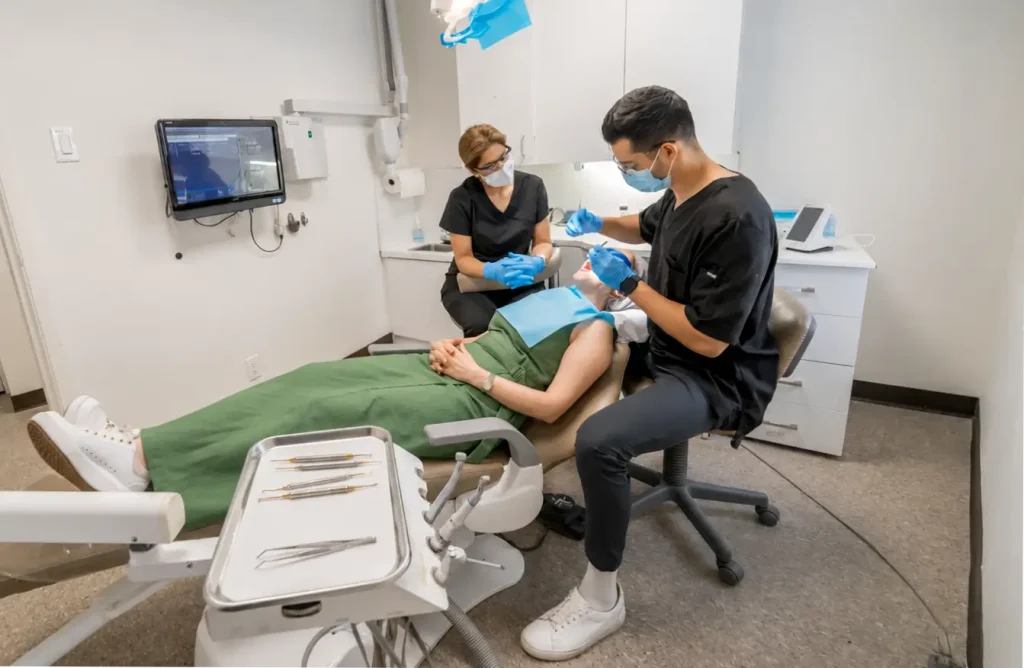
A crown covers and protects a tooth that is too damaged to hold a filling. A bridge replaces a tooth that is already gone. Both are significant pieces of work, so we explain which one your situation calls for, what it involves, and what you are likely to pay before anything is prepared.
Speak with our team to schedule your visit or ask any questions before booking your appointment.
A crown is a cover that fits over the whole tooth, restoring its shape and holding what remains of it together. There are three common reasons to need one.
A filling too large for the tooth. When decay or an old restoration has taken most of the biting surface, what is left is a shell. A filling in that situation is asked to do structural work, and the tooth tends to fracture around it later.
A cracked tooth. A crack flexes every time you bite. A crown binds the tooth and stops the movement, which is what prevents the crack from travelling further down.
After root canal treatment. A treated back tooth has had its inside hollowed out and is more brittle than it was. A crown is usually recommended afterwards to protect it, particularly on molars.
A bridge replaces one or more missing teeth using the teeth on either side of the gap as support. The replacement tooth is fixed in place, not removable.
It is worth replacing a missing tooth even when the gap is not visible. Teeth drift into empty space over time, the opposing tooth can erupt into the gap, and chewing load redistributes onto teeth that were not designed for it.
The trade off is real and we will say it: preparing a bridge means reshaping the healthy teeth on either side. That is a permanent change to two sound teeth in order to replace one missing one.
| Comparison | C Crown | B Bridge |
|---|---|---|
| What it treats | One damaged tooth still in place | One or more missing teeth |
| What gets reshaped | The damaged tooth itself | The healthy teeth either side of the gap |
| Teeth involved | One | Usually three or more |
| Removable | ✓ No, it is fixed | ✓ No, it is fixed |
| Typical appointments | Usually two | Usually two, sometimes more |
| CDCP, for eligible patients | Typically needs preauthorization | Typically needs preauthorization |
| Daily cleaning | Brush and floss as normal, with care at the gumline | Brush, plus cleaning underneath with a threader or interdental brush |
A dental implant replaces the root of the missing tooth and leaves the neighbouring teeth untouched. Where the adjacent teeth are healthy and unrestored, that is often the better long term answer. Smiles Clinic does not place implants. If an implant looks like the right option for you we will say so and discuss a referral, rather than steering you toward a bridge because a bridge is what we provide.
A partial denture is removable and replaces several teeth at once. It costs less than a bridge or an implant and it is the sensible route when there are multiple gaps, or when the teeth beside the gap are not strong enough to carry a bridge.
Speak with our team to schedule your visit or ask any questions before booking your appointment.
Visit one, preparation. The tooth is frozen and shaped so the crown has room to sit. We take an impression or a digital scan, choose the shade against your neighbouring teeth, and fit a temporary crown. Expect around 60 to 90 minutes.
In between. A dental laboratory makes the crown or bridge to the impression. typical turnaround, for example two weeks. The temporary is not as strong as the final one, so avoid hard and sticky food on that side. If it comes off, call us. It is a quick fix and it is not an emergency, but leave it and the tooth can shift enough that the final crown no longer seats.
Visit two, fitting. We remove the temporary, try the final restoration, check the shade, the contact with the neighbouring teeth and the way your bite closes, then cement it. Small adjustments at this stage are normal and are better made now than lived with.
A well made crown in a well cared for mouth commonly lasts many years, and plenty last longer than a decade. No restoration can be given a guaranteed lifespan, and any clinic offering one is promising something it does not control.
Three things shorten that life, and you control all three.
Decay at the margin. The crown itself cannot decay. The tooth underneath it can, right at the line where the two meet. That line is at the gum, and it is the spot people skip.
Gum disease. A crown sitting on a tooth with failing bone support fails with it.
Grinding and hard objects. Ice, pens and nutshells break crowns the same way they break teeth. If you grind at night, ask us about a night guard.
For a bridge, add one habit: cleaning underneath the replacement tooth daily with a floss threader or an interdental brush. Food and plaque collect in that space, and it is the most common reason a bridge fails early.
Why the fee has two parts. The clinic fee covers the dentist’s work. The laboratory fee covers making the restoration, and it appears as a separate line because it is a separate cost paid to the lab. Some clinics fold it in quietly. We show it, because you should be able to see what you are paying for.
insert the clinic’s current range for a single crown including the laboratory fee, and for a three unit bridge, and date it. If the owner prefers not to publish figures, replace with: “Call us and we will give you the full figure, lab fee included, before anything is prepared.”
Why preauthorization matters here. Crowns, bridges and dentures are the treatments the Canadian Dental Care Plan most commonly reviews before it will pay. For eligible patients, we prepare the submission with the X-rays and clinical notes the plan asks for and send it on your behalf. The plan sets its own review timeline, so no clinic can promise how long a decision takes.
Two things to know. Approval is not payment: if your eligibility or coverage changes before the date of service, the plan can still decline. And approval cannot be applied backwards, so treatment that needed it and went ahead without it is not covered afterwards.
Where the plan’s established fee is lower than ours, the difference can be billed to you. We put both numbers in front of you in writing before you agree. [CDCP dental care at Smiles Clinic]
It depends on the material, the tooth, and the laboratory fee, which is billed separately. Fees follow the Ontario Dental Association Fee Guide. We give you the full figure, lab fee included, before anything is prepared.
Crowns can be covered for eligible patients, but almost always only with preauthorization, and the plan pays according to its own established fee rather than the clinic's. We submit the request for you and tell you the expected difference before treatment.
A crown restores one damaged tooth that is still there. A bridge replaces a tooth that is gone, using the teeth either side to hold it. See the comparison above.
Many last well over a decade, but no lifespan can be guaranteed. What ends a crown early is usually decay at the gumline, gum disease, or grinding, rather than the crown itself wearing out.
For crowns, bridges and dentures under the CDCP, usually yes. We prepare and submit it. The plan sets the review timeline, so we cannot promise a turnaround.
No. If an implant is the better option for your situation we will tell you so and discuss a referral. We would rather send you to the right treatment than fit you to the one we offer.
Reviewed by [Dr. Name], DDS
Learn more about preventive, diagnostic and restorative dental care available at Smiles Clinic.
New to the clinic? A comprehensive dental exam is the right first visit.

Smiles Clinic is a family dental clinic on Kingston Road in Scarborough, providing preventive, restorative, and tooth-replacement care for patients of all ages. CDCP, IFHP, and most dental insurance accepted.